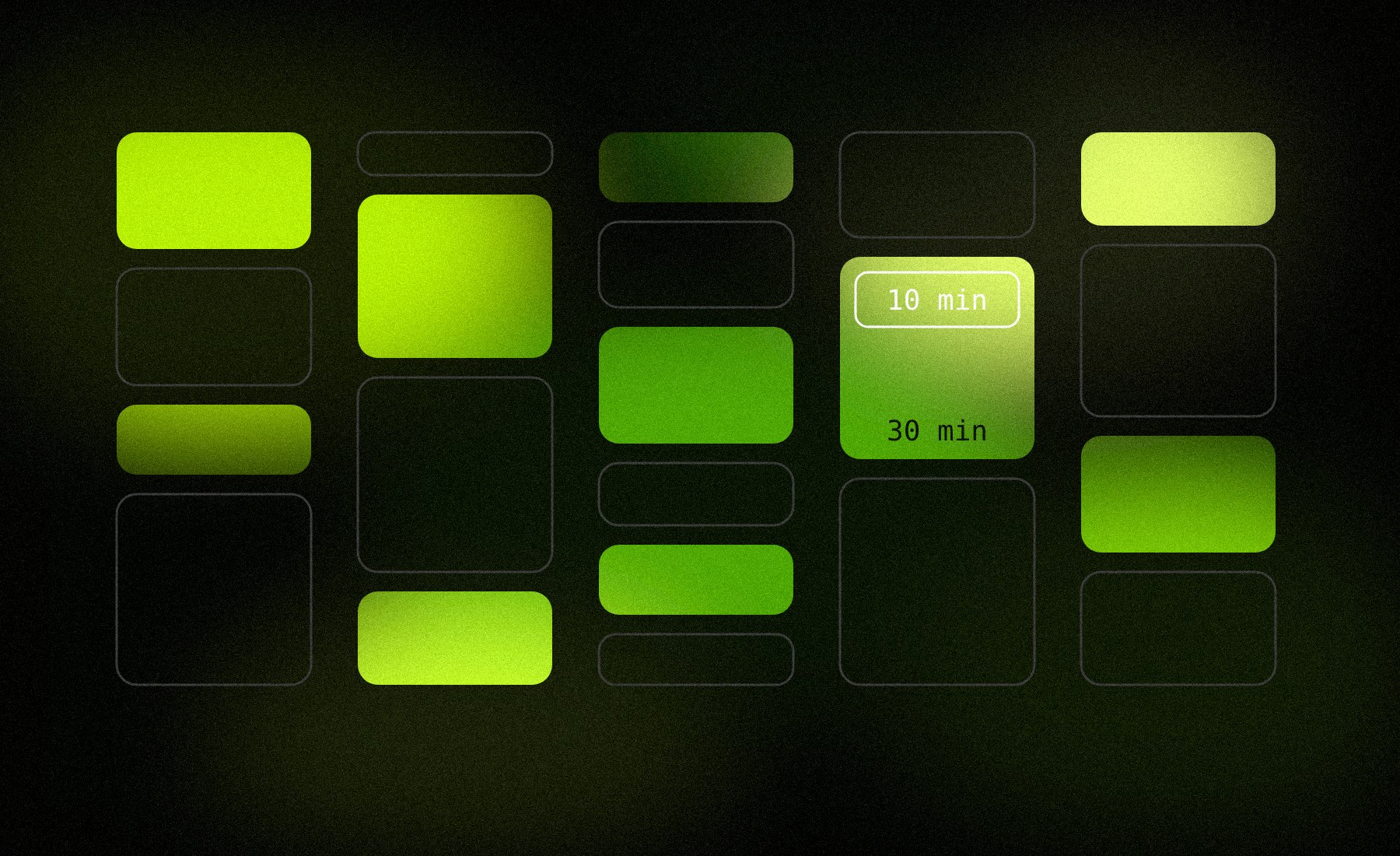
A meeting takes 30 minutes, even if the message is across after 10. Even the best AI changes little about that. Anyone who wants to calculate what AI brings to development first needs to know: which part of the week can a lever act on at all?
The answer in one sentence
About a quarter of the week is synchronously bound, only part of the rest is usable in one piece - and realistically AI tools can reach a little under half of the time.
Synchronously bound: 12 to 30%
How much time developers spend in meetings and calls depends heavily on how you measure:
- Self-reports: about 12% for communication and meetings (Kumar et al., 2025), 15% meetings on a typical day (Meyer et al., 2019).
- Calendar data: 10.9 hours per week, about 30% of recorded time - across 80,000 developers in 5,000 companies (Clockwise, 2022, calendar vendor).
The range is not a contradiction, it shows a measurement gap. Calendars miss spontaneous calls, self-reports underestimate them. In a long-term study of distributed teams, almost 9 hours of unscheduled meetings came on top of just under 8 hours of scheduled ones (Stray & Moe, 2020). Realistically the value is therefore in the upper part of the range.
What AI can do here: preparation and follow-up. In a large field experiment with over 7,000 employees, time spent on email fell by 31% with an AI assistant - meeting time did not change measurably (Dillon et al., 2025). A meeting stays a meeting.
What is left - and how much of it AI reaches
The remaining time cannot be cleanly split into “communication” and “own work”. No current independent study measures both separately. Individual building blocks are solid:
- Coding in the narrow sense: 11 to 21% of the time (Kumar et al., 2025; Meyer et al., 2017).
- Understanding code: in one measurement study, 58% of the time went into understanding programs (Xia et al., 2018). This is exactly where AI tools help: explaining, searching, summarising.
- Code review: a median of about 3 hours per week (Dorner et al., 2025, survey).
Adding up coding, understanding, testing, debugging and review lands roughly at 25 to 65% of the week, typically around 45%. That is the share of activity an AI lever can act on - as a range, not a measured single figure.
Fragmented time
Even the reachable time rarely comes in one piece:
- Calendar data show almost 20 hours per week in blocks of at least 2 hours (Clockwise, 2022). But calendars do not see chat interruptions.
- At Google, even the 90th percentile of continuous work sessions was 88 minutes (Brown et al., 2023, in-house research).
- 62% of respondents need at least 15 minutes after a meeting to get back into their work (Patkar et al., 2026, small sample).
Fragmentation costs twice: every interruption eats warm-up time, and an AI agent that takes on a longer task needs someone who checks its result in one go.
What this means for the calculation
- Take meetings out: a lever on coding does not act on the 12 to 30% of synchronously bound time.
- Range instead of a point value: the share of activity is typically around 45%, not 70% or more. In our calculation of the AI effect we therefore use 25 to 65%.
- Focus is a lever of its own: fewer and shorter meetings, more asynchronous alignment and protected blocks enlarge the time AI can act on - often faster than a new tool.
What the data do not support
The studies do not support a clean three-way split into synchronous, asynchronous and self-directed time. For asynchronous communication such as chat and tickets there is no solid overall figure for developers, and the largest current datasets come from vendors. We therefore show ranges and name the gap.
A look back as a side note: with the move to working from home in 2020, meetings became more frequent but shorter (DeFilippis et al., 2020), and synchronous communication decreased in favour of asynchronous (Yang et al., 2022). More, shorter meetings mean more fragmentation.